Key Takeaways:
- It’s better to be brief and sincere than perfect. Three to five minutes of true recollections will do.
- Organize using a simple five-part framework: Introduction, biography, personal stories, lessons learned, and a good-bye.
- Your timing will depend on the service. Formal eulogies are more common in Christian funerals; in Buddhist or Taoist services, they are often optional or informal. Always confirm the slot with your funeral organiser.
- Use whatever language your family speaks well. Mandarin, a regional dialect, or English or any combination will work.
- Be specific, not generic. A bad habit, their favorite food, or catchphrase will have more impact than vague flattery.
- Anticipate a difficult time. Type your notes in a large font and designate a family member to take over if necessary.
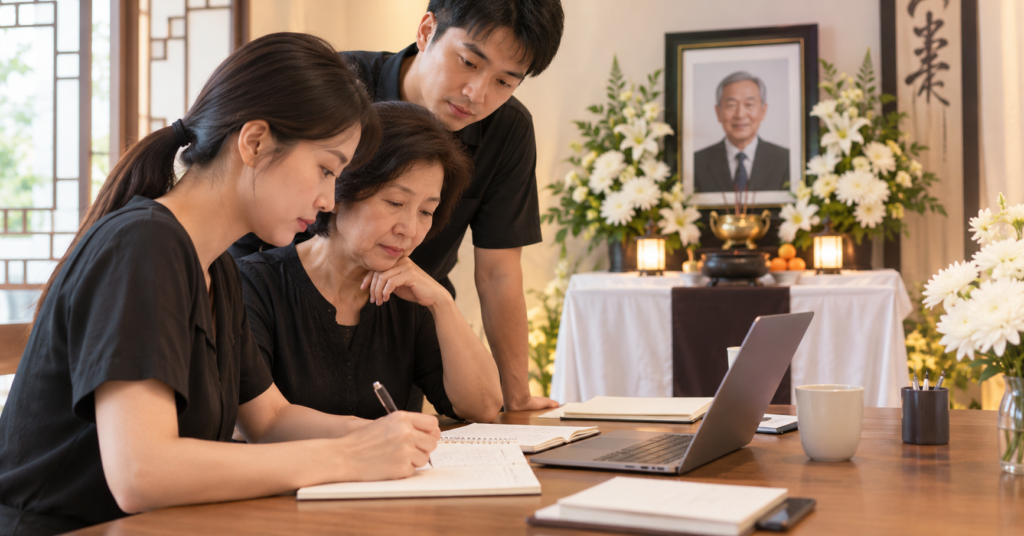
It may be a daunting task to add to a long list of other tasks if you’re asked to do a speech at your family’s funeral. Knowledge of how to write a eulogy in Malaysia might come across as another responsibility. The beauty of a eulogy is it doesn’t have to be long or even perfect. Educational and to the point. This guide shows you how to write one that fits Malaysian Chinese funeral practices.
Who Gives the Eulogy at a Chinese Funeral?
A eulogy is a spoken tribute to the person who has passed, and where it fits depends on the service.
There is no strict rule that the eldest son, daughter, or grandchild must deliver a formal eulogy. In traditional Buddhist and Taoist funerals, the eldest son (or next male heir) often leads certain ritual duties, but a spoken tribute is not a required part of the rites. Family members, siblings, grandchildren, close friends, or colleagues may speak if the family wishes.
Formal eulogies are more common in Christian Chinese funerals, where they are usually included in the order of service, with a structured time for a eulogy, scripture readings, and hymns led by a pastor.
In Buddhist or Taoist wakes, they are less traditional and more of a modern or personal addition. They may take place during the main funeral ceremony, right before the final viewing and casket closing, just before the procession to the cemetery or crematory. Always check with your funeral organiser about the best time and whether a speech is expected or simply welcome. Our guides on funeral rituals and practices in Malaysia explain the wider customs around the wake.
A Simple Structure for a Eulogy for a Chinese Funeral
In case you find yourself staring at an empty piece of paper, use the following guidelines:
- Introduction: State who you are, your relationship to the deceased, and your thanks to those who have come.
- Brief life history: Birthplace, how they brought themselves up, occupation, and family life in short sentences.
- One or two memories: Daily habits, recipes, or proverbs that they used repeatedly. Details will make the memory authentic.
- Things they taught you: Values that you now cherish, like hard work, kindness, and taking care of family members.
- Conclusion: Thank the guests, caregivers, and all other well-wishers before concluding with a simple farewell.
It is normally around three to five minutes, equivalent to 400 to 600 words spoken slowly.
Writing a Eulogy for Buddhist, Taoist & Christian Funeral
The tone follows the service.
Buddhist and Taoist funerals centre on chanting, offerings, and rituals. Any tribute is usually kept short and quiet, focusing on the person’s character and gratitude rather than a long formal speech.
If it is a Christian funeral service, then the tribute will be incorporated into the hymns and scriptures read at the funeral.
In either case, find out the time limit and the sequence of the ceremony from your coordinator.
Language used in a Eulogy
Speak in the language your guests understand most easily. Malaysian Chinese families commonly use Mandarin, Cantonese, Hokkien, Hakka, English, or a mixture. If the family is mixed, you can deliver the main message in one language and add a short heartfelt line in another, or ask a sibling to share part of the tribute in a different language.
Write the way you speak. Keep sentences short and address the person by name. Gentle humour is fine if it reflects how they lived, as long as it remains respectful.
Eulogy Examples for a Father or Mother
These are short starting points. Replace the details with your own memories.
For a father:
“Despite the lack of eloquent words, my father, [name], expressed his love through actions. For thirty years, he used to wake up early to open the shop. Every night he used to ask if we had had our meal. Now I realize that both these questions meant only one thing: he cared. Thanks, Papa, for showing us how to work hard and care about each other.”
For a mother:
“Mother, [name] did not think that anyone left her kitchen hungry. She would tell us that her soup was nothing special, but then she would fill each bowl up twice. She has shown me how generosity does not require large acts of kindness. It can just be a pot on the stove and a chair at the table. Mother, we will keep your chair and your recipes cooking.”
Notice that both lean on one or two ordinary details. That is what makes a eulogy memorable.
What to Avoid
- Disputes within the family: Not the time to settle them, especially on the occasion of the funeral.
- Speeches: More than five minutes is pushing the limit, especially in case of an all-night wake.
- The specifics about the disease or reason for death: Should only be mentioned if the family members have agreed upon that.
- Jokes that might embarrass any relative present there: Your jokes should be in praise of the departed, and not embarrassing for a relative.
- Reading from the cell phone: Be careful because the screen might go dark or lock.
Delivering It While You Are Grieving
Print your notes in large, clear font with space between lines. Practise reading them aloud a few times beforehand. Speak more slowly than usual and pause between sections. Ask a sibling, cousin, or close relative to hold a spare copy so they can continue if your voice falters. It is perfectly acceptable to cry; guests will wait with you.
Writing the Words Only You Can Say
Start with one, two, three, and continue with memories in that form. Anything you write is a means for the family to remember.
It is important to remember that a good eulogy is not judged on the quality of writing. It is regarded on its level of sincerity towards the people who loved that individual.